
Rhode Island DMV Motorcycle Practice Test 4
Test 4 of 6. Pick an answer for each question to see if it is right and why; your score appears at the end. You need 32 correct answers to pass, the same ratio as the real Rhode Island test.

- Questions40
- Correct to pass32
- Passing score80%
- Minimum age16 years
-
1. Which effect appears as a drinker's blood alcohol level climbs well past the first drinks?
Show answer
Answer D: Loss of muscle control and steady steering
Higher levels of alcohol reach the parts of the brain that control movement, which shows up as clumsy steering, late braking and poor lane control.
-
2. What identifies a helmet as certified to the federal motorcycle helmet standard?
Show answer
Answer C: A label showing DOT and the words FMVSS No. 218 CERTIFIED
Certified helmets carry a label with the DOT symbol and the wording FMVSS No. 218 CERTIFIED, together with the maker's name and the model.
-
3. A school crossing guard has returned to the curb but two children are still walking across the road. When may you go?
Show answer
Answer C: Only after the children have reached the far sidewalk
The guard leaving the road does not end your duty; you stay stopped until every child is clear of the roadway.
-
4. A yellow sign shows a truck on a slope with the legend 7 PERCENT GRADE. What should a driver of a heavy vehicle do?
Show answer
Answer A: Select a lower gear before starting down
The percentage shows how steep the descent is, and choosing a low gear at the top lets the engine hold the vehicle back instead of the brakes overheating.
-
5. What emergency exception does Rhode Island's handheld phone law recognize under 31-22-31?
Show answer
Answer C: Communicating with 911, a hospital, a doctor, or a police or fire department during a genuine emergency
31-22-31 exempts communications with emergency operators, hospitals, physicians, or police and fire departments during an emergency from the handheld phone ban.
-
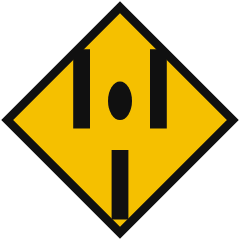
6. What should a driver do first after passing this sign?
Show answer
Answer A: Move into the right-hand lane and stay there
Traffic returns to two-way operation, so the driver keeps to the right of the centerline and stops treating the left side as available.
-
7. There is a driveway and a side street between you and the corner where you will turn right. When should you signal?
Show answer
Answer C: After passing the openings, so nobody pulls out in front of you
A signal switched on before an opening tells drivers waiting there that you are turning in, and they may pull out into your path.
-
8. How does Rhode Island General Law 31-1-3 define a motorized bicycle that qualifies for registration as a moped?
Show answer
Answer A: A two-wheel vehicle with a motor rated no more than 4.9 horsepower, no more than 50 cubic centimeters, and a top speed of no more than 30 mph
31-1-3 defines a moped-eligible motorized bicycle as a two-wheel vehicle with a motor of no more than 4.9 horsepower, no more than 50 cubic centimeters, and a top speed of no more than 30 mph.
-
9. What prima facie speed limit applies within 300 feet of a schoolhouse's entrances and exits under 31-14-2, while school is in session?
Show answer
Answer D: 20 mph
31-14-2 sets a 20 mph prima facie limit within 300 feet of a schoolhouse's entrances and exits during the hours school is in session.
-
10. A bicyclist ahead of you extends the left arm out with the forearm bent upward. What does that signal mean?
Show answer
Answer A: The bicyclist intends to turn right
Bicyclists use the same hand signals as drivers: left arm straight out means left, left arm bent up means right, and left arm bent down means stop or slow.
-
11. A bike lane on your right is marked with a dashed line for the last stretch before the corner. What does that dashed section allow you to do?
Show answer
Answer D: Merge into the bike lane after checking, and turn right from there
The dashed section is where drivers are meant to merge into the bike lane before turning, which puts cyclists behind the vehicle instead of beside it.
-
12. A separate right-turn lane leads onto the cross street and carries a yield sign. What does it require?
Show answer
Answer D: Slowing and giving way to traffic and people, stopping if needed
A yield requires you to slow, give way to traffic in the lane you are joining and to pedestrians, and stop only if that is what safety demands.
-
13. You are in the open lane where another lane is merging into yours. What is your part in the merge?
Show answer
Answer A: Keep a steady speed and leave a gap for one vehicle to come in
A merge works when each driver in the through lane lets one vehicle in, which keeps both lines moving instead of stopping them both.
-
14. What does a marked crosswalk tell a driver approaching a corner?
Show answer
Answer D: Where pedestrians are expected to cross and must be given way
Crosswalk markings show pedestrians where to cross and warn drivers to yield to anyone using the crossing.
-
15. After a Rhode Island driver reinstates a registration that was revoked for lacking insurance, what follows?
Show answer
Answer A: A 12 month monitoring period during which continued compliance with mandatory insurance is verified
Reinstatement triggers a 12 month monitoring period during which the Insurance Verification Program checks continued compliance with mandatory insurance.
-
16. When must headlights be switched on in Rhode Island?
Show answer
Answer A: From sunset to sunrise, whenever you cannot see 500 feet ahead, and any time the wipers are on
The manual requires headlights from sunset to sunrise, whenever visibility drops below 500 feet, and at any time the windshield wipers are in use.
-
17. What penalty can a Rhode Island vehicle owner face for a first offense of knowingly operating without the required insurance, under 31-47-9?
Show answer
Answer A: A suspension of up to three months and a fine of 100 to 500 dollars
31-47-9 sets a first-offense penalty of up to a three month suspension and a fine of $100 to $500 for knowingly operating without required insurance.
-
18. What can a first violation of Rhode Island's open container law under 31-22-21.1 cost a driver?
Show answer
Answer A: A fine of up to 200 dollars or a license suspension of up to six months, or both
A first open container violation under 31-22-21.1 brings a fine of up to $200 or a license suspension of up to six months, or both.
-
19. Which riders must wear a helmet under Rhode Island law?
Show answer
Answer B: All passengers, all operators under 21, and every new operator for the first year of the license regardless of age
Rhode Island requires helmets for motorcycle passengers, for operators under 21 at all times, and for new operators of any age during the first year of the license.
-
20. A yellow diamond shows a car with wavy lines behind its rear tires. What is the warning?
Show answer
Answer D: The surface loses grip badly when it is wet
The slippery when wet sign marks a stretch where traction falls off sharply in rain, so speed and braking must be reduced well in advance.
-
21. A crash happens directly in front of you and vehicles are blocking both lanes. What should you do?
Show answer
Answer B: Stop at a safe distance, put on the hazards and warn the traffic behind
The greatest danger after a crash is a second collision, so stop short of it and make sure the traffic behind you can see the problem.
-
22. What is the minimum license suspension in Rhode Island for refusing a chemical test?
Show answer
Answer C: Six months
A refusal brings a suspension of at least six months plus a fine, a highway safety assessment, community service and driving school or treatment.
-
23. Where do the greatest number of collisions involving motorcycles occur?
Show answer
Answer D: At intersections
Intersections concentrate crossing and turning paths, and the most common single event is a car turning left across the path of an oncoming motorcycle.
-
24. What rear-view mirror does Rhode Island's motorcycle equipment standard require?
Show answer
Answer B: One on the left side, showing at least 200 feet behind the vehicle with at least 10 square inches of reflective surface
Rhode Island's motorcycle inspection standard requires a left-side rear-view mirror showing at least 200 feet behind the vehicle, with a minimum of 10 square inches of reflective surface.
-
25. Besides a fine, what license suspension exposure builds up under Rhode Island's texting law, 31-22-30, across repeated convictions?
Show answer
Answer A: Up to 30 days for a first offense, up to 3 months for a second, and up to 6 months for a third
31-22-30 authorizes a license suspension of up to 30 days for a first texting conviction, up to 3 months for a second, and up to 6 months for a third or later conviction.
-
26. You are in the middle lane of a one-way street with three lanes when a police car approaches from behind with lights and siren. What should you do?
Show answer
Answer C: Pull to the nearest curb and stop clear of the lanes
On a one-way street you clear to whichever curb is closest, so the emergency vehicle gets a clear path down the open lanes.
-
27. A yellow sign reading DEAD END is posted at the entrance to a street. What does it mean?
Show answer
Answer D: The street ends and there is no way through
A dead end street stops at its far end, so a driver who enters must come back out the same way.
-
28. A sign on a freeway restricts trucks to the two right-hand lanes. What should a car driver expect in those lanes?
Show answer
Answer A: More heavy vehicles and slower changes of speed
A truck lane restriction concentrates heavy vehicles on the right, and those vehicles accelerate, brake and change lanes far more slowly than cars.
-
29. A funeral procession with headlights on is crossing an intersection when your light turns green. What should you do?
Show answer
Answer A: Wait and let the whole procession go through
Most states let a funeral procession stay together once the lead vehicle has lawfully entered an intersection, and in every state you must yield to vehicles already in the intersection, so wait until the line has passed.
-
30. You have driven at 70 mph for an hour and then exit onto a town street. What is the common risk?
Show answer
Answer B: Your sense of speed adapts, so 35 mph feels slow and you drive too fast
After a long stretch at high speed the brain adapts, so town speeds feel unnaturally slow; check the speedometer instead of trusting the feeling.
-
31. How does Rhode Island treat an autocycle for licensing purposes?
Show answer
Answer A: It is registered as a motorcycle, but a motorcycle endorsement is not required to operate it
Rhode Island registers autocycles as motorcycles, yet no motorcycle endorsement is required because they are steered with a wheel and have seating that is not straddled.
-
32. Does Rhode Island's move-over duty apply to highway maintenance equipment that is simply parked, with its flashing lights off?
Show answer
Answer B: No, the duty attaches only while the equipment is displaying flashing lights while performing maintenance operations
31-14-3 requires highway maintenance equipment to be displaying flashing lights while performing maintenance operations for the reduced-speed and move-over duty to apply.
-
33. A deer crosses the road in front of you and disappears into the trees. What should you expect?
Show answer
Answer B: That other deer are likely to follow it across the very same stretch of road
Deer usually move in groups, so one crossing the road is a warning that more may follow.
-
34. What does Rhode Island regulation say about selling or exchanging value for a vehicle's registration plates?
Show answer
Answer D: It is expressly prohibited, and violating plates face immediate suspension and revocation
Rhode Island regulation 280-RICR-30-10-1 expressly prohibits exchanging money or value for a transfer of registration plates, and violating plates face immediate suspension and revocation.
-
35. Under Rhode Island's motorcycle equipment standard, within what distance must a motorcycle stop from 20 mph?
Show answer
Answer B: 40 feet
Rhode Island's motorcycle inspection standard requires a motorcycle to stop within 40 feet from 20 mph, or decelerate at 10.7 feet per second squared.
-
36. You are behind a snow plow working on a highway. What is the correct way to drive?
Show answer
Answer C: Stay well back and do not try to pass it
A plow throws snow, runs wider than its body and works on the poor surface ahead of it, so the cleared road behind it is the safest place to be.
-
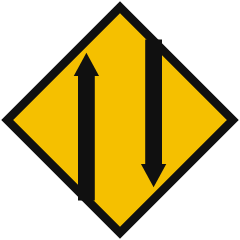
37. What is a driver being warned about here?
Show answer
Answer B: The pavement ahead carries vehicles traveling in the opposite direction
Beyond this point vehicles come the other way on the same pavement, which commonly happens where a one-way section or a separated stretch comes to an end.
-
38. Why is dusk one of the harder times of day to drive?
Show answer
Answer B: The failing light blurs shapes into the background
In fading light there is not enough contrast to pick objects out, yet it is not dark enough for headlights to do the work, so pedestrians and cyclists disappear.
-
39. Well before an intersection, an overhead sign shows a diagram of the lanes with an arrow above each one. What is its purpose?
Show answer
Answer C: To let drivers pick the correct lane in good time
Advance intersection lane control signs display the lane assignment far enough back that drivers can move over calmly instead of at the last moment.
-
40. On traffic control devices, the color green shows direction to a destination and also shows
Show answer
Answer C: that a movement is permitted
Green carries two assignments: guidance toward destinations, and the idea that the movement shown is allowed, as on a green arrow.