
Rhode Island DMV Motorcycle Practice Test 3
- Questions40
- Correct to pass32
- Passing score80%
- Minimum age16 years
-
1. How is a wheel bearing checked during an inspection?
Show answer
Answer A: Raise the wheel clear of the ground and rock it side to side to feel for play
A worn bearing shows itself as side to side play in a raised wheel, and it may also feel rough or notchy when the wheel is spun.
-
2. How does a NO OUTLET sign differ from a DEAD END sign?
Show answer
Answer B: It warns that a whole group of streets has no way out
No Outlet is posted where the road leads into a network of streets from which there is no through route, while Dead End refers to the single street itself.
-
3. Why should a rider avoid riding through a puddle that spans the lane?
Show answer
Answer D: It can hide a deep hole or broken pavement under the surface
Standing water conceals what is underneath it, so treat a puddle as an unknown surface and go around it whenever you safely can.
-
4. Which shape is used for the school advance warning sign and the school crossing sign?
Show answer
Answer B: An upward-pointing pentagon
The five-sided pentagon with its point up identifies school signing, so the outline alone tells a driver that children may be present.
-
5. How much clear road do driver manuals say you need before starting a pass at highway speed on a two-lane road?
Show answer
Answer C: Enough to complete the pass and return, roughly ten to twelve seconds of travel
At highway speed the whole maneuver of pulling out, overtaking and returning takes roughly ten to twelve seconds, and every foot of that has to be visible before you start.
-
6. What is the PRIME position on a fuel supply valve used for?
Show answer
Answer D: To let fuel flow into the carburetor after the machine has stood unused
PRIME bypasses the normal vacuum control and lets fuel refill an empty carburetor, which helps a machine start after sitting for a long time.
-
7. What does a blood alcohol concentration of 0.08 mean for the driver of a car?
Show answer
Answer B: It is the level almost every state treats as legally intoxicated
In almost every state a driver at 0.08 or above is legally intoxicated whatever the driver seems like, but impairment starts well before that level is reached.
-
8. What should be adjusted on the motorcycle before carrying a passenger?
Show answer
Answer C: The suspension and the tire pressure, following the owner's manual
The extra weight compresses the suspension and loads the tires, so both should be set to the values the manufacturer specifies for riding with a passenger.
-
9. Why is passing on a curve prohibited even when the traffic seems light?
Show answer
Answer C: You cannot see far enough around it to know the lane is clear
A pass is only as safe as the distance you can see, and a curve hides the very lane the maneuver uses.
-
10. Apart from other vehicles, who else must a driver let go first at this sign?

Show answer
Answer A: Pedestrians and cyclists already in or entering the crossing
The duty to give way covers every road user who has the right of way at that point, including people walking or cycling across the driver's path.
-
11. No plaque stating days or hours accompanies this sign at the intersection. When does the restriction apply?
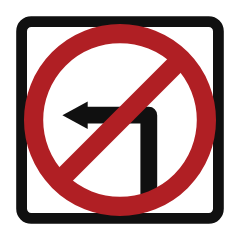
Show answer
Answer D: At all times, since nothing limits it to particular periods
A regulatory restriction runs continuously unless a supplemental plaque states the days or hours during which it applies.
-
12. May you stop briefly across the sloped ramp that joins the sidewalk to the street at a corner?
Show answer
Answer B: No, that ramp must stay clear for people using wheelchairs
A curb ramp is the only way many people can get from the sidewalk to the crosswalk, so blocking it even briefly is prohibited.
-
13. A yellow diamond showing arrows arranged in a circle warns of
Show answer
Answer B: a circular intersection such as a roundabout ahead
The circular intersection warning sign announces a roundabout or traffic circle so drivers can slow down and prepare to yield to traffic already circulating.
-
14. You are driving down a parking aisle and reach the main lane that runs along the front of the store. What is the usual rule?
Show answer
Answer C: The main through lane has the right of way over the vehicles leaving the aisles
In a parking lot the wide lane that runs across the ends of the aisles works like a through road, and drivers leaving an aisle yield to it.
-
15. You are approaching a traffic light that has been green for a long time. How should you treat it?
Show answer
Answer C: Expect it to change and be ready to stop
A light that has been green for a while is called a stale green light. Cover the brake and decide in advance where you could still stop safely.
-
16. What is the best way to keep your phone from distracting you on a trip?
Show answer
Answer D: Silence it and stow it before you start
A phone you cannot hear and cannot reach cannot tempt you, which is far more reliable than deciding case by case while you drive.
-
17. Enhanced reference location markers differ from ordinary mileposts in that they
Show answer
Answer B: carry the route number and a mileage figure to the tenth of a mile
An enhanced reference location marker adds the route designation and carries the mileage to a tenth, so the point named is far more precise than a plain milepost.
-
18. How long does a Rhode Island vehicle owner have to request a hearing after being mailed notice of a registration revocation for lack of insurance verification?
Show answer
Answer C: 10 days
Under Rhode Island's Insurance Verification Program regulation, an owner has 10 days after the notice is mailed to request a hearing before the registration is revoked.
-
19. Where should the hooks of an elastic luggage cord be attached?
Show answer
Answer D: To solid points on the frame or the rack that will take the pull
Hooking a cord to bodywork, a signal stalk or a cable can break the part or damage the wiring, and the load is loose the moment the anchor fails.
-
20. A dog runs out and chases your motorcycle. What is the recommended response?
Show answer
Answer D: Downshift and approach slowly, then accelerate away as you reach the animal
Approaching slowly keeps the dog aiming at where you are now, and accelerating as you reach it leaves the animal behind without a sudden swerve.
-
21. You are on a country road with no sidewalk and two people are walking toward you on your side of the shoulder. What should you do?
Show answer
Answer C: Slow down and move over to give them room
Where there is no sidewalk, people are expected to walk on the shoulder facing traffic, and drivers must slow and give them space.
-
22. You want to turn right at a steady red light and no sign prohibits the turn. What is required?
Show answer
Answer B: Come to a complete stop, then yield to traffic and pedestrians before turning
A right turn on a steady red is permitted only after a complete stop and only after yielding to cross traffic and to pedestrians, and a posted sign can prohibit it entirely.
-
23. Why is a shoulder check especially important on a road with motorcycles and bicycles?
Show answer
Answer D: A narrow vehicle can disappear completely in the blind spot
A motorcycle or a bicycle is small enough to be hidden entirely by a door pillar or by the blind spot the mirrors do not cover.
-
24. A lane along the right edge is set off by a solid white line and marked with a bicycle symbol. How should a driver treat it?
Show answer
Answer B: Stay out of it except for the short distance needed to turn or cross where that is allowed
A marked bicycle lane is set aside for bicycle traffic, and motor vehicles may enter it only briefly where turning or crossing is permitted.
-
25. Which warning sign keeps its yellow background even when it is used inside a work zone?
Show answer
Answer D: The grade crossing advance warning sign
The round grade crossing advance warning sign keeps its black legend on yellow inside temporary traffic control zones because the railroad hazard it describes is not temporary.
-
26. The green arrow protecting your turn changes to a steady yellow arrow. What is it telling you?
Show answer
Answer A: The protected turn is ending and you should prepare to stop
A steady yellow arrow warns that the arrow movement is being terminated and that a red indication will follow.
-
27. How should a face shield be cleaned?
Show answer
Answer C: With mild soap and water and a soft cloth, then dried gently
Plastic shields scratch easily and are damaged by solvents, and a scratched shield scatters light badly at night, so use mild soap, water and a soft cloth.
-
28. It is very hot and a rider is tempted to take off the riding jacket. Why can that make the heat worse?
Show answer
Answer C: A bare arm in hot moving air loses fluid fast and burns in the sun
In hot, dry air a covering layer slows the evaporation of sweat and blocks the sun, so ventilated gear can keep a rider cooler and better hydrated than bare skin.
-
29. A driver ignores this sign and passes on the opposite side. What is the main risk?
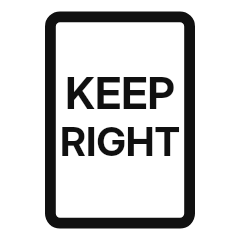
Show answer
Answer B: Ending up on the wrong side of a divider, facing traffic coming the other way
The sign settles which side of a fixed divider is the legal one, so taking the other side sends the vehicle into the opposing stream or straight at the obstruction.
-
30. A downpour has just started on a street with a visible dark strip down the middle of the lane. Where should you ride?
Show answer
Answer A: In the left or right portion of the lane, away from the greasy center strip
Dripped oil and grease build up in the center of the lane, and water floats that film to the top, so the tire tracks on either side offer better grip.
-
31. You are making a U-turn at a signal on a green left arrow. Who must you still watch for?
Show answer
Answer D: People in the crosswalk you will cross as you come around
Even a protected arrow does not clear the crosswalk, and a U-turn sweeps across a crosswalk that pedestrians may already be using.
-
32. Studies of damaged helmets show that the most frequently struck area is which part?
Show answer
Answer C: The chin and jaw area, which an open face helmet leaves uncovered
The chin and face area takes a large share of helmet impacts, which is the main safety argument for a full face helmet over an open face one.
-
33. Your car begins to lose power on a freeway and you must stop. Where should you try to bring it to a halt?
Show answer
Answer A: As far off the right side of the road as you can get, beyond the edge line
A disabled vehicle should be moved completely clear of the travel lanes, on the right, so that traffic can pass without changing course.
-
34. A driver is tailgating you. Why is it a bad idea to tap or stab the brakes to warn them?
Show answer
Answer C: Because it cuts the little space they have and can cause a crash
Brake checking removes the small margin the tailgater has left and can provoke a collision; add space in front of you instead and let them pass.
-
35. Your light is green but the traffic beyond the intersection is stopped and there is no room on the far side. What should you do?
Show answer
Answer A: Wait behind the line until you can clear the far side
Entering an intersection you cannot clear blocks the cross traffic when their signal turns green, so you wait behind the line.
-
36. On a regulatory sign, what does a red circle with a diagonal slash drawn over a symbol mean?
Show answer
Answer D: The movement or action shown by the symbol is prohibited
A red circle with a diagonal slash is the standard way of showing that the movement pictured inside it, such as a U-turn or a right turn, is not allowed.
-
37. Apart from giving you room to stop, what else does a longer following gap do for you?
Show answer
Answer D: It widens your view of the road and the traffic ahead
Sitting further back lets you see past and around the vehicle in front, so hazards reach your eyes seconds earlier.
-
38. On a long, straight highway you feel your attention fading. What helps you stay alert?
Show answer
Answer A: Keep your eyes moving, scan mirrors and signs, and take regular breaks
Staring at one point brings on highway hypnosis. Active scanning keeps the mind engaged, and a break every couple of hours restores alertness.
-
39. What does a yield sign require of a driver?
Show answer
Answer A: Slow down, and stop when necessary, so conflicting traffic can go first
A yield sign obliges the driver to reduce to a speed suited to conditions and to stop when needed so that conflicting traffic or pedestrians are not interfered with.
-
40. Does wearing properly fitted earplugs stop a rider from hearing important sounds?
Show answer
Answer C: No, they lower overall noise while horns and speech still register
Earplugs reduce the wind roar that masks everything else, so riders wearing them often hear traffic more clearly, not less, while their hearing is protected.