
Rhode Island DMV Permit Practice Test 7
Test 7 of 10. Pick an answer for each question to see if it is right and why; your score appears at the end. You need 32 correct answers to pass, the same ratio as the real Rhode Island test.

- Questions40
- Correct to pass32
- Passing score80%
- Minimum age16 years
-
1. When may a Rhode Island driver move from a Limited Provisional License to a full operator's license before turning 18?
Show answer
Answer B: At 17, after holding the provisional license 12 months and with no motor vehicle conviction in the preceding six months
A driver at least 17 but under 18 may obtain a full license after 12 months on the limited provisional license with no motor vehicle conviction in the previous six months; otherwise the license upgrades at 18.
-
2. You come upon a crash that has just happened and decide to help. Where should you stop your vehicle?
Show answer
Answer A: Well beyond the scene, completely off the road, with the hazard lights on
Stopping past the crash and off the pavement keeps you from becoming another victim and leaves the approach clear for emergency vehicles.
-
3. What happens to traffic fines in a Rhode Island work zone marked with signs declaring the zone under General Law 31-14-12.1?
Show answer
Answer C: They are doubled: the total fines, penalties, and costs are twice the amount otherwise set by law
When a temporary traffic control zone is posted under 31-14-12.1, a conviction there carries fines, penalties, and costs equal to twice the amount otherwise set by law.
-
4. Your engine stalls while you are driving in traffic. What is the correct response?
Show answer
Answer A: Shift to neutral, try to restart it, and steer and brake toward the side of the road
With the engine off, power steering and power brake assistance fade, so steering and braking take more effort but still work. Neutral lets you attempt a restart while you coast to safety.
-
5. A shared-use path crosses the road ahead at a marked crossing and people are already crossing on it. What should you do?
Show answer
Answer C: Yield and let them finish crossing the road
People already crossing at a marked crossing have the right of way, and a path crossing is a crossing of the roadway like any other.
-
6. What is the best way to keep your phone from distracting you on a trip?
Show answer
Answer D: Silence it and stow it before you start
A phone you cannot hear and cannot reach cannot tempt you, which is far more reliable than deciding case by case while you drive.
-
7. A wheel comes off your car while you are driving. What should you do?
Show answer
Answer A: Hold the wheel firmly, ease off the gas and steer gently to the shoulder
A firm grip and a gradual slowing keep the vehicle straight, while hard or sudden braking makes a damaged corner pull the car out of line.
-
8. Besides emergency vehicles showing flashing lights, which other vehicles trigger Rhode Island's reduced-speed and move-over duty under 31-14-3?
Show answer
Answer C: Tow trucks, transporter trucks, and highway maintenance equipment displaying flashing lights while working
31-14-3 extends the reduced-speed and move-over duty to tow trucks, transporter trucks, and highway maintenance equipment displaying flashing lights while performing work.
-
9. What does a booster seat do for a child?
Show answer
Answer B: It lifts the child so that the adult belt crosses hips and shoulder
A booster raises the child so the adult belt lies on the strong parts of the body instead of the neck and the abdomen.
-
10. On a long, straight highway you feel your attention fading. What helps you stay alert?
Show answer
Answer A: Keep your eyes moving, scan mirrors and signs, and take regular breaks
Staring at one point brings on highway hypnosis. Active scanning keeps the mind engaged, and a break every couple of hours restores alertness.
-
11. How does a second insurance offense under 31-47-9 compare with a first, in terms of suspension length?
Show answer
Answer C: The suspension doubles to six months, with a fine of 500 dollars or more
A second offense under 31-47-9 doubles the suspension to six months and raises the fine to $500 or more.
-
12. How does a wet road change the distance you need to stop?
Show answer
Answer C: It lengthens it, so you need a much bigger gap ahead
Water between the tire and the road cuts grip, so braking distance grows and the gap that works on dry pavement is no longer enough.
-
13. Your vehicle has daytime running lights. Why should you still switch on the headlights at dusk?
Show answer
Answer B: Daytime running lights usually do not light the tail lights, so you are hard to see from behind
On many vehicles the daytime running lights illuminate only the front. Without the headlight switch on, the rear of the vehicle stays dark and the dash may still look lit.
-
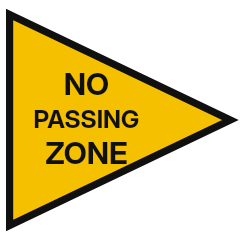
14. A driver is thinking about overtaking a slower vehicle and sees this sign a short distance ahead. What does it mean for that pass?
Show answer
Answer B: The pass must be finished before the restricted section begins
The sign marks the start of a section where passing is prohibited, so a driver may not be on the left side of the road beyond it; any pass has to be completed before that point or not started at all.
-
15. What vision standard does Rhode Island's Medical Advisory Board use to certify a driver as legally blind for a disability parking placard?
Show answer
Answer A: Central visual acuity of 20/200 or less in the better eye with best correction, or a visual field no greater than 20 degrees
Rhode Island's Medical Advisory Board certifies legal blindness for disability parking purposes at a central visual acuity of 20/200 or less in the better eye with best correction, or a visual field of no more than 20 degrees.
-
16. Can a Rhode Island applicant request a driver license knowledge exam in a language other than English?
Show answer
Answer B: Yes, at the Registrar's discretion and by appointment only, upon payment of a reasonable fee
Rhode Island regulation allows a foreign language driver license exam at the Registrar's discretion, given by appointment only, upon payment of a reasonable fee.
-
17. How can you check that you are keeping a safe following distance?
Show answer
Answer A: Count at least three seconds between the vehicle ahead passing a fixed object and your reaching it
Pick a fixed roadside object, start counting when the vehicle ahead passes it and make sure at least three seconds elapse before you reach it, adding more time in poor conditions.
-
18. In a work zone one lane sits an inch or two lower than the lane beside it. How should you change lanes?
Show answer
Answer C: Slow down and cross the edge at a shallow angle, holding the wheel firmly
A vertical edge between lanes can catch a tire and jerk the steering. Crossing slowly at a shallow angle lets the wheel climb without grabbing.
-
19. How should a head restraint be adjusted?
Show answer
Answer D: So the top is at least as high as the back of your head and close behind it
A restraint set at head height and close behind limits how far the head snaps backward in a rear impact, which is what reduces neck injury.
-
20. The inside of your windshield keeps fogging up on a cold, damp day. What clears it best?
Show answer
Answer B: The defroster with the air conditioning on, which dries the air
Fog on the inside is moisture from the cabin air. The air conditioner dries that air, and the defroster warms the glass, so together they clear it and keep it clear.
-
21. A pedestrian waiting at a curb faces a steady upraised hand. What does that indication mean?
Show answer
Answer A: Do not start to cross in that direction
A steady upraised hand forbids entering the crosswalk, while a flashing hand only forbids starting a new crossing.
-
22. A barricade carries a sign reading ROAD CLOSED TO THROUGH TRAFFIC. What does it permit?
Show answer
Answer B: Local access for people whose destination is on that road
This closure keeps out drivers who are only passing through while still allowing residents and deliveries to reach addresses within the closed section.
-
23. You come up behind a bicyclist who is descending a steep hill in the middle of the traffic lane. What should you take into account?
Show answer
Answer D: The rider may be moving at close to the speed of the traffic
A bicycle can reach the speed of traffic on a descent, so there is little to gain from a pass and the rider needs the whole lane to steer around surface hazards.
-
24. You are in the right-hand lane of a multilane street and that lane becomes a right-turn-only lane ahead, but you want to go straight. What should you do?
Show answer
Answer B: Change into a through lane before you reach the markings for the turn lane
A lane-use arrow is a regulatory marking, so a driver who wants to continue straight has to leave that lane before it becomes a mandatory turn lane.
-
25. You are approaching a marked school crossing and children have started to cross the roadway. What is required?
Show answer
Answer A: Stop and let the children finish crossing the roadway
Drivers give way to people in a marked crossing, stopping if that is what it takes, and children in particular may change direction without warning.
-
26. You have turned onto a ramp at night and your headlights pick out large white arrows painted on the pavement pointing straight back at you. What do they mean?
Show answer
Answer C: You are traveling against the flow and must turn back
Wrong-way arrows are laid so that a driver going the correct way never sees them head on, so an arrow pointing at you means you are on the ramp backwards.
-
27. How long is a Rhode Island Limited Instruction Permit valid?
Show answer
Answer B: One year or until the holder turns 18, whichever is greater
The permit is valid for one year or until the applicant turns 18, whichever is greater.
-
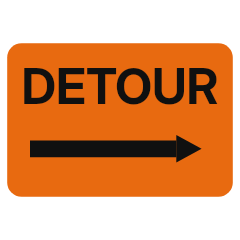
28. Once a driver has joined the route this sign begins, how is the rest of the way marked?
Show answer
Answer B: By further markers of the same kind at each turn, until the original road is rejoined
The alternate route is signed continuously, with a marker at every turn, so a driver with no local knowledge can follow it back to the original road.
-
29. Why should you avoid parking over tall dry grass or a pile of dead leaves?
Show answer
Answer B: Because the hot exhaust can set the dry material on fire
The exhaust system stays hot for a long time after a drive and can ignite dry vegetation underneath the vehicle.
-
30. Your vehicle has antilock brakes. What should you never do in an emergency stop?
Show answer
Answer A: Pump the pedal up and down
The system already releases and reapplies the brakes many times a second. Pumping the pedal interrupts it and makes the stop longer.
-
31. During a Rhode Island DMV random insurance audit, how long does an owner have to verify active coverage before facing penalties?
Show answer
Answer C: 20 days
Under 280-RICR-30-10-2, a vehicle owner has 20 days to verify active insurance coverage during a DMV random audit before facing suspension and fines.
-
32. You have brought the vehicle under control after a blowout. What should you do next?
Show answer
Answer A: Signal and coast well off the road before stopping
Let the speed fall, signal, and leave the roadway as far from traffic as you can before you stop. Driving on a failed tire ruins the wheel and risks control.
-
33. What do the grooves in a tire tread do on a flooded road surface?
Show answer
Answer B: They give the water a way to escape so the tread can touch the road
Tread grooves pump water out from under the tire so rubber can meet pavement. A worn tread moves less water, so hydroplaning starts sooner.
-
34. A ball rolls into the street from between parked cars ahead of you. What should you expect and do?
Show answer
Answer A: Expect a child to follow it and be ready to stop
A ball is usually followed by a child who is watching the ball and not the traffic. Slow down and be prepared to stop immediately.
-
35. Where does Rhode Island's move-over statute, 31-14-3, direct courts to look for the applicable fine on a violation?
Show answer
Answer A: To the fine schedule set out in General Law 31-41.1-4
31-14-3 makes a violation subject to the fine schedule set out in 31-41.1-4, rather than fixing a specific dollar amount within the section itself.
-
36. Why is passing another vehicle a bad idea in dense fog?
Show answer
Answer C: You cannot see far enough ahead to know the passing lane is clear
A pass needs a clear view of the road well beyond the vehicle you are overtaking, and fog takes exactly that away.
-
37. Under General Law 31-27-2, what does a second Rhode Island DUI conviction bring, compared with a first offense?
Show answer
Answer D: Six to twelve months in jail, a fine of up to 1000 dollars, and a license suspension of up to two years
A second DUI conviction under 31-27-2 carries six to twelve months in jail, a fine of up to $1,000, and a license suspension of up to two years.
-
38. The vehicle in front of you has stopped and is waiting to turn left, and there is a paved shoulder to the right. May you use it to get by?
Show answer
Answer D: No, in most states a pass may not be made by leaving the paved travel lanes
Passing on the right is normally lawful only inside the marked travel lanes, and most states prohibit driving onto the shoulder to get around a turning vehicle; the few states that allow it attach strict conditions.
-
39. You are driving through a long curve on a road with two lanes in your direction. What is correct?
Show answer
Answer A: Stay within your own lane all the way through, adjusting speed before you enter
Wandering out of your lane in a curve puts you into the path of a vehicle you cannot see, and the slowing belongs before the curve rather than in it.
-
40. A yellow pennant, an isosceles triangle with its long axis horizontal, is reserved for which message?
Show answer
Answer D: No passing zone
The pennant shape is used only for the no passing zone sign, which marks the point where overtaking is no longer allowed.