
Rhode Island DMV Permit Practice Test 4
Test 4 of 10. Pick an answer for each question to see if it is right and why; your score appears at the end. You need 32 correct answers to pass, the same ratio as the real Rhode Island test.

- Questions40
- Correct to pass32
- Passing score80%
- Minimum age16 years
-
1. A person using a wheelchair is waiting to cross at a corner ahead. How should you treat that person?
Show answer
Answer B: As a pedestrian with the right of way at the crossing
A wheelchair or a mobility scooter user has the rights of a pedestrian, so yield the whole crossing and wait until the crossing is finished.
-
2. The sign over the leftmost lane reads LEFT LANE MUST TURN LEFT. You are in that lane and want to go straight. What should you do?
Show answer
Answer C: Move out of the lane before the intersection if it is safe
A mandatory movement lane control sign makes the turn compulsory for that lane, so a driver who wants another movement must change lanes in advance.
-
3. What changes about a chemical test refusal charge in Rhode Island the second time it happens within five years?
Show answer
Answer A: It becomes a misdemeanor carrying up to six months in jail, a fine of 600 to 1000 dollars, 60 to 100 hours of community restitution, and a one to two year suspension
A second refusal within five years is a misdemeanor: up to six months in jail, a $600 to $1,000 fine, 60 to 100 hours of community restitution, and a one to two year suspension.
-
4. On loose gravel or deep fresh snow, how does an antilock system affect the stopping distance?
Show answer
Answer D: It can lengthen it, although you keep the ability to steer
On loose surfaces a locked wheel piles up a wedge of gravel or snow that helps it stop, so the antilock stop can be longer even though steering still works.
-
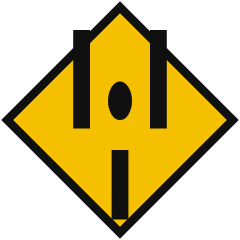
5. What change in the road does this sign announce?
Show answer
Answer B: The two directions of travel are about to be separated, and the driver must keep to the right of the separation
Ahead the roadway splits into separate one-way roadways on either side of a median, so the driver stays to the right of the divider and no longer meets oncoming vehicles.
-
6. How often must a Rhode Island vehicle over 8,500 pounds gross weight undergo its required safety inspection?
Show answer
Answer A: Every year
Vehicles exceeding 8,500 pounds gross weight require an annual safety-only inspection in Rhode Island, unlike the biennial cycle for lighter vehicles.
-
7. What is the only reliable remedy for a driver who is sleepy?
Show answer
Answer A: Sleep
Caffeine, fresh air and noise may make you feel alert for a few minutes, but they do not remove the need for sleep. Stop somewhere safe and rest.
-
8. You have finished a distracting task and your eyes are back on the road. What is true?
Show answer
Answer A: Your full attention takes a while to come back
Studies of drivers show attention lags behind the eyes for many seconds after a phone or a screen task, so the danger continues after the task is over.
-
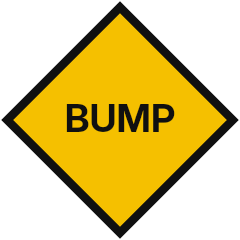
9. How should a driver respond to this sign?
Show answer
Answer C: Slow down before reaching the rough spot and cross it at a steady, low speed
Losing speed before a sharp rise in the pavement keeps the vehicle settled, while braking or accelerating on top of it unsettles the suspension and costs grip.
-
10. How much supervised driving experience must a Rhode Island applicant certify before a Limited Provisional License?
Show answer
Answer C: A minimum of 50 hours, 10 of them at night
A parent or guardian must sign an affidavit stating that the applicant completed at least 50 hours of driving with a supervising driver, including 10 hours at night.
-
11. How does a second or later conviction for passing a stopped school bus in Rhode Island compare with a first conviction under General Law 31-20-12?
Show answer
Answer C: It brings a mandatory fine of 300 to 500 dollars and/or a one year license revocation
A second or later conviction for passing a stopped school bus carries a mandatory fine of $300 to $500 and/or a one year license revocation, harsher than the first-offense penalty.
-
12. A pedestrian using a white cane or walking with a guide dog starts to cross the street ahead of you. What must you do?
Show answer
Answer A: Yield and stay stopped until the person has finished crossing
A white cane or guide dog identifies a pedestrian who may not be able to see your vehicle, so you must yield and wait rather than maneuver around the person. The horn can confuse the pedestrian or the dog.
-
13. You are the second vehicle waiting to turn left on a green ball. Where should you wait?
Show answer
Answer A: Behind the stop line, until the first vehicle has actually turned
Only the lead vehicle should move into the intersection to wait; a second vehicle inside it is likely to be stranded there when the light changes.
-
14. You are at a red light where right turns on red are allowed, you cannot see clearly, and the driver behind sounds the horn. What should you do?
Show answer
Answer C: Stay stopped until you can see that the turn is safe
Turning right on red is permitted, never required, so you wait until you can see that the way is clear no matter what the driver behind does.
-
15. A left-turn bay opens ahead of the intersection with a solid white line beside it. Where should you enter the bay?
Show answer
Answer C: At the opening before the solid line begins
The solid line marks where lane changes are no longer intended, so you move into the turn bay at its opening rather than cutting across the line later.
-
16. How does Rhode Island General Law 31-1-3 define a motorized bicycle that qualifies for registration as a moped?
Show answer
Answer A: A two-wheel vehicle with a motor rated no more than 4.9 horsepower, no more than 50 cubic centimeters, and a top speed of no more than 30 mph
31-1-3 defines a moped-eligible motorized bicycle as a two-wheel vehicle with a motor of no more than 4.9 horsepower, no more than 50 cubic centimeters, and a top speed of no more than 30 mph.
-
17. You are turning right off a street into a parking lot driveway that crosses a bike lane and a sidewalk. Who has the right of way?
Show answer
Answer D: Pedestrians on the sidewalk and riders in the bike lane
Turning into a driveway means crossing the paths of people who were already traveling straight, so you give way to both the bike lane and the sidewalk.
-
18. A NO LEFT TURN sign carries a plaque reading 7 AM TO 9 AM MON TO FRI. What does the assembly mean?
Show answer
Answer A: The turn is banned only during those hours on those days
A time plaque limits the restriction to the periods shown, so outside those hours and days the left turn may be made normally.
-
19. How is Rhode Island's safety belt law enforced?
Show answer
Answer B: As a primary law for all ages, so a driver can be stopped simply because someone is unbuckled
The seat belt use law is a primary law for all ages in Rhode Island, and the fine is 40 dollars per unbelted occupant.
-
20. When may a driver of a motor vehicle use a marked bicycle lane?
Show answer
Answer C: Only to cross it when turning or entering the road where the markings allow
A bike lane is a lane for cyclists. Motor vehicles may only cross it to enter or leave the road or to make a turn where the markings permit.
-
21. You have finished parallel parking at the curb. How should the vehicle sit?
Show answer
Answer A: Close to the curb, so that it does not stick out into the traffic lane
A parked vehicle must sit close enough to the curb that it does not intrude into the path of passing traffic; the exact maximum distance is set by each state.
-
22. Four vehicles reach a four-way stop from all four directions at the same instant. How is the deadlock resolved?
Show answer
Answer C: Each driver yields to the vehicle on the right and they go one by one
Yielding to the right applies to every driver, so the group untangles itself as drivers take turns rather than moving together.
-
23. Traffic is heavy and a truck is stopped in the lane on your right. How do you keep an out?
Show answer
Answer B: Keep space open ahead of you and avoid being boxed in on both sides at once
Being hemmed in on both sides with no gap ahead removes every option, so keep at least one direction open.
-
24. You park on level ground in a lot. Where should the front wheels be pointing?
Show answer
Answer C: Straight ahead, so the car would not veer if it moved
On the level the wheels go straight so that the car stays in its own space, and so that a shunt from behind does not send it across a lane.
-
25. How much following distance should you keep behind a motorcycle?
Show answer
Answer C: At least three to four seconds
A motorcycle can slow or stop very quickly and is easily upset by a surprise, so allow three to four seconds instead of the usual car gap.
-
26. A large X with the letters R and R beside it is painted across your lane. What does it mean?
Show answer
Answer A: A railroad crossing lies a short distance ahead
The pavement marking repeats the advance warning for a grade crossing, and it is used on paved approaches where speeds are high or where gates are installed.
-
27. Two solid white lines separate your lane from the lane beside it. What do they mean?
Show answer
Answer B: Crossing from one lane to the other is prohibited
A solid double white line marks a boundary that road users may not cross, such as the entrance to a preferential lane.
-
28. What is the proper use of the horn?
Show answer
Answer C: To give a brief warning when another road user may not have seen you
The horn is a warning device meant to alert someone to your presence when a collision is possible, and using it in anger tends to escalate conflict rather than prevent crashes.
-
29. A sign reads REDUCED SPEED LIMIT AHEAD. What does it tell you?
Show answer
Answer D: A lower limit begins further along the road
The sign gives advance notice so a driver can slow gradually, and the new figure takes effect at the speed limit sign that follows.
-
30. What is the main function of the guide sign series?
Show answer
Answer D: To identify routes and lead road users to their destinations
Guide signs identify routes, name destinations and give distances, so drivers can navigate without stopping to consult a map.
-
31. A driver slows to walking pace at this sign, never stops rolling and eases into the intersection. How is that treated?

Show answer
Answer B: It is a violation, because the vehicle never came to a complete halt
What is required is a full halt with the wheels no longer turning, so slowing down, however carefully, does not satisfy it.
-
32. Does Rhode Island law allow tire chains on public roads?
Show answer
Answer B: Yes, chains of reasonable proportions are permitted when needed for safety because of snow, ice, or similar conditions
31-23-20 permits tire chains of reasonable proportions when required for safety because of snow, ice, or other conditions tending to cause skidding.
-
33. By when must a Rhode Island driver comply with the move-over or reduced-speed duty once a covered vehicle comes into view?
Show answer
Answer A: As soon as it is safe to do so, not merely at some point before passing
31-14-3 requires the driver to comply as soon as it is safe to do so, establishing a prompt duty rather than an open-ended one.
-
34. You are approaching the entry of a roundabout and a pedestrian is crossing the marked crosswalk on your approach lane. What must you do?
Show answer
Answer D: Stop before the crosswalk and let the pedestrian cross
Roundabout crosswalks sit a short distance back from the yield line, and drivers must yield there before they ever reach the circulating lanes.
-
35. You wait in the aisle with your signal on for a space that is about to be vacated. What is the risk?
Show answer
Answer D: You block the aisle and drivers behind may try to squeeze past
A stopped vehicle turns a two-way aisle into a bottleneck, and drivers who try to get around it pass close to pedestrians and reversing cars.
-
36. Once you are moving, which way of using a navigation device costs you the least attention?
Show answer
Answer B: Listening to the spoken directions
Voice guidance lets you keep your eyes on the road, while anything that needs the screen takes glances that add up over a trip.
-
37. Which child must ride in a rear seat in an approved child restraint system under Rhode Island law?
Show answer
Answer A: A child under 8 who is less than 57 inches tall and weighs less than 80 pounds
Rhode Island General Law 31-22-22 requires a child under eight years old, under fifty-seven inches tall and under eighty pounds to ride restrained in a rear seating position.
-
38. How long must a Rhode Island Limited Instruction Permit be held before the road test may be taken?
Show answer
Answer C: Six months
A road test may not be given until the permit has been held for six months, although the appointment may be scheduled when the permit is issued.
-
39. Your navigation device tells you to turn where a road sign says the turn is closed. What should you do?
Show answer
Answer B: Follow the signs and what you can see
A device works from stored data that can be out of date, while signs and the road in front of you show the situation now, so the road wins every time.
-
40. A sign beside the signal reads STOP HERE ON RED. What does it tell you?
Show answer
Answer B: Stop at that point on red, not closer to the intersection
The sign marks the required stopping point, which is set back from the corner so that turning vehicles and sight lines are not blocked.