
Rhode Island DMV Permit Practice Test 31
- Questions40
- Correct to pass32
- Passing score80%
- Minimum age16 years
-
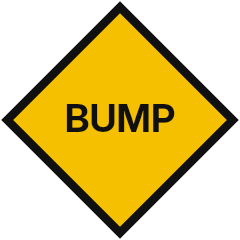
1. How should a driver respond to this sign?
Show answer
Answer C: Slow down before reaching the rough spot and cross it at a steady, low speed
Losing speed before a sharp rise in the pavement keeps the vehicle settled, while braking or accelerating on top of it unsettles the suspension and costs grip.
-
2. A notification appears on your smart watch while you are driving. What should you do?
Show answer
Answer B: Treat it as you would a phone and leave it
A watch screen demands the same eyes and the same attention as a phone, and a wrist is no safer a place to read a message than a dashboard.
-
3. A center lane is bordered by a solid yellow line on the outside and a broken yellow line on the inside, with left-turn arrows painted in it. How may you use that lane?
Show answer
Answer A: Only to make a left turn or to prepare for one from either direction
That marking identifies a two-way left turn lane, which may only be used for left turns or to prepare for a left turn and never for travel or passing.
-
4. You are traveling beside a solid white lane line. What does it tell you?
Show answer
Answer B: Crossing it is discouraged or prohibited, so stay in your lane
A solid white line separates lanes going the same direction where lane changing is discouraged or prohibited, such as where a through lane meets a mandatory turn lane.
-
5. Where should a rear-facing infant seat never be placed?
Show answer
Answer C: In a front seat with an active passenger air bag
A deploying front air bag strikes the back of a rear-facing seat with enormous force. Rear-facing seats belong in the back seat.
-
6. What does Rhode Island require of every driver regarding liability insurance?
Show answer
Answer D: Proof of insurance must be carried in the vehicle with the registration, and failure to comply carries a fine of up to 500 dollars
All drivers on Rhode Island public roads must carry motor vehicle liability insurance, and proof must be kept in the vehicle with the registration at all times; driving without it carries a fine of up to 500 dollars and possible license suspension.
-
7. A small signal face beside a bikeway shows red, yellow and green lenses that each carry a bicycle symbol. Whom does it control?
Show answer
Answer C: Bicyclists using that crossing or bikeway
A bicycle signal face governs bicycle movements only, and people on foot at the same corner still follow the pedestrian signal.
-
8. According to the Rhode Island Driver's Manual, what is the speed limit in residential areas?
Show answer
Answer B: 25 miles per hour
Rhode Island sets 25 miles per hour in residential areas, while most highways run between 50 and 65 miles per hour.
-
9. You have printed directions or paperwork you need to check. When should you read them?
Show answer
Answer C: Before you leave, or after you park
Reading takes eyes and mind off the road for far longer than any safe glance, and a light that changes while you read leaves you moving off blind.
-
10. When is switching traction control off sometimes useful?
Show answer
Answer A: When you need spinning wheels to rock out of deep snow or mud
Rocking a stuck vehicle free needs the wheel spin that the system normally prevents. Switch it back on as soon as you are moving again.
-
11. On traffic control devices, the color green shows direction to a destination and also shows
Show answer
Answer C: that a movement is permitted
Green carries two assignments: guidance toward destinations, and the idea that the movement shown is allowed, as on a green arrow.
-
12. Alcohol is classified as which kind of drug?
Show answer
Answer B: A depressant that slows the central nervous system
As a depressant, alcohol slows the brain and nervous system, which lengthens reaction time and dulls the coordination that driving depends on.
-
13. You are following another vehicle down a long, steep grade. What should you do about the gap?
Show answer
Answer D: Make it longer, because both of you need more room to stop
Everything takes longer to stop on a downgrade, including the vehicle ahead, so the gap that works on the flat is no longer enough.
-
14. You are the first to arrive at a crash on a rural road. What should you do first?
Show answer
Answer C: Park well clear of the scene, put on your hazard lights and call for help
Getting trained help on the way and keeping the scene visible does more good than anything an untrained bystander can do.
-
15. On a two-lane road, a solid yellow line runs on your side of the center while a broken yellow line runs on the other side. What does this mean?
Show answer
Answer D: You may not pass, although oncoming drivers may
Passing restrictions are read from the line closest to your own lane, so a solid yellow line on your side creates a no-passing zone for you alone.
-
16. An oncoming vehicle at night has its high beams on and you are being dazzled. Where should you look?
Show answer
Answer A: Toward the right edge of your lane
Looking toward the right edge line keeps you on course while sparing your eyes the worst of the glare. Slow down and do not retaliate with your own high beams.
-
17. What injury does a correctly set head restraint help prevent?
Show answer
Answer A: A neck injury of the kind caused when your vehicle is struck from behind
In a rear impact the body is pushed forward and the head restraint stops the head from whipping backward.
-
18. You are entering a marked work zone. What should you expect?
Show answer
Answer B: A reduced posted speed, narrowed or shifted lanes, and traffic that may stop suddenly
Work zones change the geometry of the road and can bring traffic to a halt without warning, so the posted work zone speed and increased following distance both apply.
-
19. How should a turn at an intersection be taken on a wet road?
Show answer
Answer C: Slow earlier than usual and steer smoothly through the corner
Wet pavement leaves less grip, so the speed must come off before the turn and the steering must be gentle enough not to break traction.
-
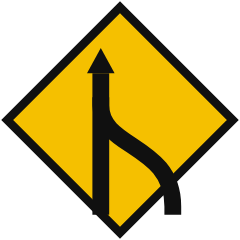
20. What is the safest way to deal with the situation this sign announces?
Show answer
Answer B: Match the speed of the other traffic stream and open a gap so vehicles can blend without hard braking
Blending works when speeds are matched and gaps are opened, so nobody has to brake hard or swerve where the two streams come together.
-
21. At a railroad crossing with no gates and no flashing lights, the crossbuck is normally combined with which sign?
Show answer
Answer C: A yield sign, or a stop sign where an engineering study calls for one
At a passive crossing the crossbuck forms an assembly with a yield sign, or with a stop sign when an engineering study or engineering judgment supports it, so the driver knows who must give way to the train.
-
22. What does the solid white line running along the right side of a highway mark?
Show answer
Answer A: The right edge of the traveled way
A solid white edge line shows where the traveled way ends on the right, which is particularly useful at night and in poor visibility.
-
23. Your vehicle has stalled on railroad tracks and no train is in sight. After getting everyone away, whom should you call first?
Show answer
Answer B: The railroad emergency number posted on the blue sign at the crossing, giving the crossing number
Every public crossing has a blue emergency notification sign with a phone number and a crossing identification number. That call lets the railroad stop or slow trains before they reach you.
-
24. Your light is green but the traffic beyond the intersection is stopped and there is no room on the far side. What should you do?
Show answer
Answer A: Wait behind the line until you can clear the far side
Entering an intersection you cannot clear blocks the cross traffic when their signal turns green, so you wait behind the line.
-
25. How do strong emotions affect driving?
Show answer
Answer B: They narrow your attention and make risky decisions more likely
Anger, worry and excitement all take attention away from the driving task and push drivers toward decisions they would not normally make.
-
26. You are already inside a roundabout when an emergency vehicle approaches with lights and siren. What should you do?
Show answer
Answer B: Continue to your exit, leave the roundabout, then pull over and stop
Stopping inside a roundabout blocks the circulating roadway, so you should exit first and then pull over clear of the intersection.
-
27. You park facing downhill on a one-way street where the curb is on your left. Which way do the front wheels go?
Show answer
Answer A: Left, toward the curb on that side
Standard practice follows the curb rather than the side of the road: facing downhill the wheels point into the curb so a rolling vehicle is stopped by it. States differ on whether this is legally required.
-
28. A bicyclist is riding in the middle of a narrow travel lane ahead of you. What is the correct response?
Show answer
Answer D: Slow down and wait until you can pass with wide clearance, changing lanes if needed
A bicyclist has the same right to use the lane as a driver, and a narrow lane may not leave safe passing room, so wait for a gap that lets you move over and pass with a wide margin.
-
29. Which warning sign keeps its yellow background even when it is used inside a work zone?
Show answer
Answer D: The grade crossing advance warning sign
The round grade crossing advance warning sign keeps its black legend on yellow inside temporary traffic control zones because the railroad hazard it describes is not temporary.
-
30. Someone has stepped into a marked crosswalk in the middle of a block ahead of you. What should you do?
Show answer
Answer A: Slow down, stop before the markings and let the person cross the street
A marked mid-block crosswalk carries the same duty as one at a corner: give way to the person crossing, stopping if that is what letting them cross safely takes.
-
31. Are tow trucks and transporter trucks legally 'emergency vehicles' under the Rhode Island statute that requires drivers to move over or slow down for them?
Show answer
Answer B: No, they are listed separately from emergency vehicles but are still covered by the same reduced-speed and move-over duty
31-14-3 lists tow trucks and transporter trucks separately from authorized emergency vehicles, yet still covers them under the same reduced-speed and move-over duty.
-
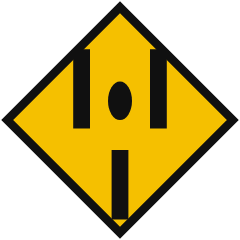
32. What must a driver be ready for beyond this sign?
Show answer
Answer C: Vehicles approaching from the opposite direction in the next lane over
The separation between the two directions runs out, so from that point oncoming vehicles share the same pavement and the driver has to keep right.
-
33. What is wrong with steering through a turn using the palm of one hand on the wheel?
Show answer
Answer D: You have less control and cannot correct quickly if something goes wrong
One-handed palming gives poor leverage and slow response. Use hand-to-hand or hand-over-hand steering with both hands so you can react instantly.
-
34. In the code that governs pavement markings, what does a double line stand for?
Show answer
Answer B: A maximum restriction
The marking code is consistent: a double line means the strongest restriction, a solid line discourages or forbids crossing, and a broken line is permissive.
-
35. Another driver has pulled out to pass you. What should you do?
Show answer
Answer A: Stay in your lane, keep your speed steady or ease off, and let the pass finish
Accelerating while being passed forces the other driver to stay in the opposing lane longer, so the safe response is to hold or slightly reduce speed and stay right.
-
36. You are turning left across tracks that run along the center of the street. What should you do before crossing them?
Show answer
Answer B: Look along the tracks in both directions and cross only when clear
Rail vehicles running in the street can arrive from either direction and cannot stop quickly, so look along the tracks before you turn across them.
-
37. Where is a strong crosswind most likely to hit you suddenly?
Show answer
Answer D: Coming out of a tunnel or a cut onto an open bridge
Gusts arrive the moment you leave shelter, which is why bridge approaches and the ends of cuts and tunnels catch drivers out.
-
38. An entrance ramp joins a highway just before an exit ramp leaves it. What should you expect in that short section?
Show answer
Answer D: Vehicles crossing paths as some enter and others leave
In a weaving section entering traffic moves left while exiting traffic moves right over the same short stretch, so lane changes there need extra room and extra care.
-
39. A yellow pennant, an isosceles triangle with its long axis horizontal, is reserved for which message?
Show answer
Answer D: No passing zone
The pennant shape is used only for the no passing zone sign, which marks the point where overtaking is no longer allowed.
-
40. How does Rhode Island classify a second or later reckless driving conviction under 31-27-4?
Show answer
Answer D: As a felony, exposing the driver to up to five years in prison
A second or subsequent reckless driving conviction is a felony under 31-27-4, exposing the driver to up to five years in prison.