
Rhode Island DMV Permit Practice Test 26
- Questions40
- Correct to pass32
- Passing score80%
- Minimum age16 years
-
1. How do stimulant drugs such as amphetamines or cocaine typically affect driving?
Show answer
Answer D: They can make the driver overconfident and more willing to take risks
Stimulants create a false sense of alertness and encourage aggressive, risky driving. When they wear off, sudden fatigue can follow.
-
2. Who may be issued a Rhode Island Limited Instruction Permit?
Show answer
Answer D: A resident who is 16 but under 18 and has completed the required driver education course
The Limited Instruction Permit is for Rhode Island residents aged 16 to under 18 who have completed the certified driver education course and passed the computerized knowledge exam.
-
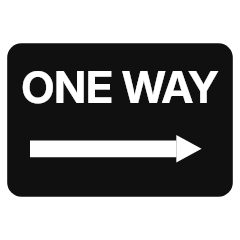
3. Where are signs of this kind placed at an intersection?
Show answer
Answer C: At the near right and far left corners, facing drivers on the intersecting street
They are installed at the corners of the intersecting street so that a driver about to turn in sees the restriction before committing to the turn.
-
4. A yellow diamond shows a horse with a rider. Besides slowing down, what else should a driver do?
Show answer
Answer C: Avoid using the horn or revving the engine
The equestrian crossing sign warns of horses on or across the road, and a sudden noise can startle an animal into the traffic lane.
-
5. You are turning left into a street that is divided by a raised median. Which side should you enter?
Show answer
Answer C: The right-hand roadway, so that you travel on the proper side
A raised median separates two directions of travel, so the turn must be completed into the roadway carrying traffic your way.
-
6. You are in a passing zone that continues over the crest of a hill ahead. May you start a pass?
Show answer
Answer B: Only if you can finish it well before the crest
Beyond the crest you cannot see oncoming traffic, so any part of the pass that happens there is being made blind.
-
7. You reach a red light with a sign reading NO TURN ON RED. What may you do?
Show answer
Answer D: Wait for the green; no turn is allowed while the light is red
That sign removes the usual permission to turn on red at the intersection, so you must wait for a green indication.
-
8. Where should you be looking as you steer through a turn?
Show answer
Answer C: Toward the point on the new road where you want to end up
Drivers steer toward what they look at, so looking through the turn to where you want to go keeps the path smooth and accurate.
-
9. You must leave your vehicle beside a narrow rural road at night. What should you do?
Show answer
Answer B: Get it right off the pavement and switch on the hazard lights
A vehicle left on an unlit rural road is very hard to see, so move it completely clear of the traveled surface and mark it with the hazard lights.
-
10. Yellow signs each showing one large black arrowhead, installed in a row along the outside of a curve, are
Show answer
Answer D: chevron alignment signs marking the change of direction of the curve
Chevron alignment signs are placed on the outside of a curve so that several are in view at once, letting the driver judge how sharply the road turns.
-
11. An overhead sign shows that the right lane is EXIT ONLY. What does that mean if you intend to stay on the highway?
Show answer
Answer B: You have to move out of that lane before the exit
An exit only lane leaves the highway completely, so a driver continuing on the highway has to change lanes before it does.
-
12. Which vehicle is most affected by a strong side wind?
Show answer
Answer D: A van or a car towing a tall trailer
Wind pushes against the side area of a vehicle, so tall boxy shapes and trailers are moved far more than low heavy ones.
-
13. A pedestrian steps off the curb in the middle of a block where there is no crosswalk at all. What is the legal position?
Show answer
Answer A: They must yield to you, but you must still avoid a crash
A pedestrian crossing away from a crosswalk yields to vehicles, yet every driver still has a duty to use care and avoid hitting a person.
-
14. What two options does a Rhode Island driver have when approaching a stopped vehicle covered by the move-over law under 31-14-3?
Show answer
Answer D: Move into a lane not nearest the stopped vehicle, or reduce speed and maintain it until safely past
31-14-3 gives drivers two compliance paths: move into a lane that is not nearest the stopped vehicle, or reduce speed and maintain a safe reduced speed until completely past.
-
15. You are turning right from a one-way street onto a two-way street. Where should the turn end?
Show answer
Answer A: In the lane nearest the right curb of the street you are entering
A right turn starts and finishes as close to the right as practical, so you leave the one-way street from the right lane and arrive in the lane nearest the right curb.
-
16. A city transit bus at a stop ahead of you switches on its left signal. What should you do?
Show answer
Answer D: Slow and let the bus pull back into traffic
A bus needs a long gap to rejoin traffic, and yielding to a signaling transit bus keeps the whole line of traffic moving safely.
-
17. You are driving through a residential area where parked cars hide the side streets. What is the safest approach?
Show answer
Answer C: Slow down and cover the brake as you pass each opening
Where parked vehicles hide side streets and driveways, lower speed and a covered brake buy the time you lose in sight distance.
-
18. The posted limit is 55 mph, but heavy traffic and rain make that speed unsafe. What does the law expect of you?
Show answer
Answer D: You must slow to a speed that is safe for the conditions
The basic speed rule requires a speed that is reasonable for the traffic, weather and road, and that speed is often well below the posted maximum.
-
19. You are waiting inside the intersection to turn left when your light turns red. What should you do?
Show answer
Answer A: Complete the turn as soon as the way is clear
Once you have legally entered the intersection you should clear it as soon as the oncoming traffic has stopped, rather than sit in the path of cross traffic.
-
20. The road is icy and visibility is poor, but you are driving at the posted speed limit. Is this acceptable?
Show answer
Answer A: No, because you may never drive faster than is safe for the conditions
Under the basic speed rule a driver must travel at a speed that is reasonable for the actual conditions, so a legal posted speed can still be an unlawful and unsafe speed.
-
21. The gates at a railroad crossing begin to come down as you approach. What must you do?
Show answer
Answer A: Stop and wait until the gates are fully raised and the lights stop flashing
Once the gates start down you must stop clear of the tracks and wait until they are fully raised and the warning lights have stopped.
-
22. At many crossings the walk indication appears only after a button is pressed. What happens if a pedestrian does not press it?
Show answer
Answer B: The signal may cycle without showing a walk indication
An actuated pedestrian phase is called in by the pushbutton, so without it the controller may serve the vehicle movements alone.
-
23. A lane is marked with a large white bicycle symbol and chevrons, but there is no separate bicycle lane. What does it mean?
Show answer
Answer A: Bicyclists may use the whole lane, so follow or pass with care
A shared lane marking shows that bicyclists and drivers use the same lane and positions riders away from parked car doors, so passing means changing lanes.
-
24. How can you keep space at the sides of your vehicle in heavy traffic?
Show answer
Answer D: Drive in the gaps between the other vehicles rather than beside them
Travelling in the open spaces rather than alongside others keeps a way out open on at least one side.
-
25. On a rural road, the driver of a slow farm tractor ahead of you signals a left turn even though there is no road or driveway in sight. What should you do?
Show answer
Answer B: Stay behind the tractor, because it may be turning into a field entrance
Farm equipment often turns into fields through gaps you cannot see, and it may swing wide to do so. Passing a vehicle that is signaling a left turn is a common cause of crashes.
-
26. You reach a stop-controlled intersection at the same time as a driver on your left, but that driver is already moving through the crossing. Who goes first?
Show answer
Answer C: The driver who is already inside the intersection
A vehicle already in the intersection has the right of way, and the rule about yielding to the right applies only before anyone has entered.
-
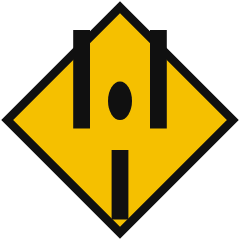
27. What change in the road does this sign announce?
Show answer
Answer B: The two directions of travel are about to be separated, and the driver must keep to the right of the separation
Ahead the roadway splits into separate one-way roadways on either side of a median, so the driver stays to the right of the divider and no longer meets oncoming vehicles.
-
28. Your low beams light about 250 feet of road, but at your speed you would need more than that to stop. What is that called?
Show answer
Answer D: Overdriving your headlights
When your stopping distance is longer than the stretch of road your headlights show, you cannot react to anything you finally see. Slow down until you can.
-
29. What does a steady yellow traffic light tell the driver facing it?
Show answer
Answer A: The green movement is ending and a red indication is about to appear
A steady yellow warns that the related green movement is being terminated and that red will follow, so you should stop if you can do so safely.
-
30. You are driving on the through road of a T-intersection and want to turn left into the side road. Oncoming traffic is approaching on the through road. What must you do?
Show answer
Answer C: Yield to the oncoming traffic before you turn
The vehicle waiting in the stem of the T yields to both of you, but you still owe the right of way to oncoming through traffic before turning across it.
-
31. Why is passing another vehicle a bad idea in dense fog?
Show answer
Answer C: You cannot see far enough ahead to know the passing lane is clear
A pass needs a clear view of the road well beyond the vehicle you are overtaking, and fog takes exactly that away.
-
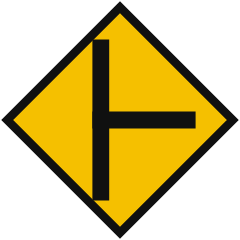
32. What condition does this sign warn a driver about?
Show answer
Answer B: Another road joins the road being traveled, from one side
It announces a side road entering the main roadway, so the driver should expect vehicles waiting to pull out and other vehicles slowing to turn in.
-
33. A yellow diamond shows an arrow bent into a series of reversing turns. What does it warn about?
Show answer
Answer A: Three or more changes of direction close together
The winding road sign replaces a string of separate curve signs where several bends follow one another with only short straights between them.
-
34. A wheel comes off your car while you are driving. What should you do?
Show answer
Answer A: Hold the wheel firmly, ease off the gas and steer gently to the shoulder
A firm grip and a gradual slowing keep the vehicle straight, while hard or sudden braking makes a damaged corner pull the car out of line.
-
35. At an intersection where turning right on red is permitted and no sign prohibits it, what must you do before turning?
Show answer
Answer A: Come to a complete stop and yield to pedestrians and cross traffic
A right turn on red is allowed only after a full stop, and the turning driver must yield to pedestrians in the crosswalk and to traffic already using the intersection.
-
36. You reach an intersection with no signs, signals or markings clearly before a vehicle that is approaching on your right. What is the rule?
Show answer
Answer B: You may go first because you got there first
At an uncontrolled intersection the first driver to arrive goes first; the yield to the right rule only settles a tie.
-
37. You have turned right into the nearest lane but you need the left lane soon. When should you move over?
Show answer
Answer A: After the turn is finished, once you have checked mirrors and blind spot
Complete the turn in the proper lane first, then make a normal lane change with mirror and blind spot checks once you are established on the new street.
-
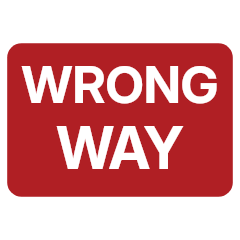
38. This sign comes into view ahead of a driver who has already started along a ramp. What should the driver do?
Show answer
Answer B: Pull clear where it is safe, then turn around and leave the ramp traveling properly
The driver is traveling against the legal flow, so the safest response is to stop clear of the lanes, turn the vehicle around and get off the ramp before meeting traffic head on.
-
39. You reach a stretch of road covered by moving flood water of unknown depth. What is the correct decision?
Show answer
Answer D: Turn around and take another route
About a foot of moving water is enough to carry away most cars, and the roadbed under the water may already be washed out, so the only safe choice is to turn around.
-
40. A flashing red arrow is displayed for your turning lane. What does it require?
Show answer
Answer D: Stopping, then turning when the way is clear
A flashing red arrow is treated like a stop sign for that movement: come to a full stop, then turn when it is safe and no one has to be cut off.