
Rhode Island DMV Permit Practice Test 14
- Questions40
- Correct to pass32
- Passing score80%
- Minimum age16 years
-
1. You get into a heated argument with a passenger while driving. What should you do?
Show answer
Answer D: End the discussion or pull over to finish it
Anger narrows attention and encourages risk, and a conversation you cannot let go of is a passenger you should be parked to talk with.
-
2. When should headlights be switched on besides during the hours of darkness?
Show answer
Answer C: Whenever rain, fog, snow or dust makes it harder to see or to be seen
Headlights are as much about being seen as about seeing, so they go on whenever visibility drops.
-
3. A strong wind is blowing across an open stretch of road. Besides the gusts, what else should you watch for?
Show answer
Answer A: Branches, dust and loose objects blown into your path
High wind strips branches, litter and dust onto the roadway and can push other vehicles out of their lane, so scan much further ahead than usual.
-
4. Which family of signs normally uses a rectangle that is wider than it is tall?
Show answer
Answer B: Guide signs, which name routes and destinations
Guide signs are laid out as horizontal rectangles because they have to carry route numbers, place names and distances side by side.
-
5. Where is a road work ahead sign placed?
Show answer
Answer B: In advance of the work space or detour, so drivers are warned before reaching it
Advance warning signs are placed upstream of the work space or detour so that drivers have time to slow down and change lanes before reaching the activity.
-
6. A yellow pennant-shaped sign is posted on the left side of a two-lane road facing you. What is it telling you?
Show answer
Answer B: You are entering a no-passing zone and may not start a pass
The pennant is placed on the left so that it faces the driver who might pull out, and it marks the beginning of a no-passing zone.
-
7. Your vehicle has broken down at night on a rural road and your phone has no signal. What is the safest thing to do?
Show answer
Answer C: Stay with the vehicle, keep the hazard lights on and wait for help
A lit vehicle is far easier to find than a person walking in the dark, and running the engine while you sleep risks carbon monoxide.
-
8. What should you expect while driving through a parking lot?
Show answer
Answer D: Pedestrians and vehicles moving from any direction, so drive slowly
Parking lots mix walking people, reversing vehicles and poor sight lines, so low speed and constant scanning are the only reliable protection.
-
9. You are leaving a freeway on an exit ramp posted with an advisory speed of 25 mph. Where should you slow to that speed?
Show answer
Answer A: In the deceleration lane, before you reach the curve of the ramp
Slowing belongs in the deceleration lane so you arrive at the curve already at the advisory speed and do not hold up traffic still in the through lanes.
-
10. At a freeway exit, the paved triangle between the ramp and the through lanes is filled with diagonal white lines. What do they mean?
Show answer
Answer A: Stay out of that area, because it is not meant to be driven on
Chevron and diagonal markings fill paved areas that traffic is not intended to use, so drivers should keep out of them.
-
11. You must slow suddenly on a highway and a vehicle is following close behind you. What helps prevent a rear-end collision?
Show answer
Answer D: Tapping the brake pedal early so your brake lights flash a warning
Early brake light flashes give the driver behind more time to react, and slowing gradually instead of suddenly reduces the chance of being struck.
-
12. Your car begins to lose power on a freeway and you must stop. Where should you try to bring it to a halt?
Show answer
Answer A: As far off the right side of the road as you can get, beyond the edge line
A disabled vehicle should be moved completely clear of the travel lanes, on the right, so that traffic can pass without changing course.
-
13. Your navigation device tells you to turn where a road sign says the turn is closed. What should you do?
Show answer
Answer B: Follow the signs and what you can see
A device works from stored data that can be out of date, while signs and the road in front of you show the situation now, so the road wins every time.
-
14. You are about to drive a rental car that you have never driven before. What should you do?
Show answer
Answer A: Adjust the seat and the mirrors and find the controls before moving off
Hunting for the wipers or the lights in traffic is a distraction, so learn the layout while the vehicle is stopped.
-
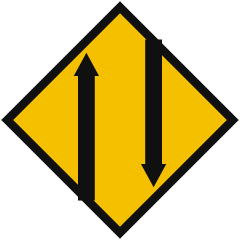
15. What is a driver being warned about here?
Show answer
Answer B: The pavement ahead carries vehicles traveling in the opposite direction
Beyond this point vehicles come the other way on the same pavement, which commonly happens where a one-way section or a separated stretch comes to an end.
-
16. You are traveling at 55 mph on a rural road and come up behind a horse-drawn buggy. What is the main danger?
Show answer
Answer D: You close on it very quickly because it moves at walking pace
A buggy travels only a few miles an hour, so the gap closes far faster than drivers expect and there is very little time to brake once you see it.
-
17. A fire truck with lights and siren has just passed you and is heading down the same road. How closely may you follow it?
Show answer
Answer B: Well back, because following a responding emergency vehicle closely is illegal
Following a responding emergency vehicle closely is prohibited; the exact minimum distance is set by each state, so stay far enough back to keep the scene and other responders clear.
-
18. Which color scheme is standard for the drums and barricades that channel traffic through a work zone?
Show answer
Answer C: Alternating orange and white retroreflective stripes
Drums and barricades carry alternating orange and white retroreflective stripes, and the traffic cones used in the same zones are predominantly orange.
-
19. The driver of a slow farm vehicle moves partly onto the shoulder and waves you past. Who is responsible for the pass?
Show answer
Answer A: You are, so pass only if you can see that the road is clear
A courtesy wave is not a traffic control, and the driver who changes lanes is the one answerable for the maneuver.
-
20. Is dictating a message by voice a safe alternative to typing one?
Show answer
Answer C: No, it still takes attention from driving
Composing and checking a spoken message loads the mind and usually pulls the eyes to the screen anyway, so research finds it no safer than other phone use.
-
21. You are in the right-hand of two left-turn lanes and the vehicle beside you starts to drift toward your lane during the turn. What should you do?
Show answer
Answer B: Slow slightly, keep to your own lane and give the other vehicle room
Drivers commonly drift wide in dual turn lanes, so hold your own line, ease off and leave space rather than racing or crowding the other vehicle.
-
22. Why is smooth, early braking better than hard, late braking?
Show answer
Answer D: It keeps you in control and gives the driver behind more warning
Braking early and gently keeps the tires well within their grip and gives following drivers time to react to your brake lights.
-
23. What does it mean to cover the brake, and when should you do it?
Show answer
Answer B: Hold your foot over the brake pedal without pressing it when a hazard seems likely
Covering the brake cuts reaction time when you expect trouble, such as near children, parked cars or a vehicle that may pull out. Riding the brake wears it out and confuses drivers behind you.
-
24. How can you check that you are keeping a safe following distance?
Show answer
Answer A: Count at least three seconds between the vehicle ahead passing a fixed object and your reaching it
Pick a fixed roadside object, start counting when the vehicle ahead passes it and make sure at least three seconds elapse before you reach it, adding more time in poor conditions.
-
25. Blue pavement markings are used together with white markings at
Show answer
Answer D: parking spaces reserved for people with disabilities
Blue supplements the white markings of accessible parking spaces, which is the only assignment blue has on the pavement.
-
26. A pedestrian starts to cross against a Do Not Walk signal, right in front of you. What should you do?
Show answer
Answer D: Slow or stop and let the person reach safety
Even when a pedestrian is crossing unlawfully, a driver must take reasonable care to avoid hitting that person.
-
27. A truck passes you in heavy rain and its spray blanks out your windshield. What should you do?
Show answer
Answer B: Hold the wheel steady, ease off slightly and let the wipers clear it
The blackout lasts a second or two. Keeping your line and easing off is far safer than braking hard or steering blind toward the shoulder.
-
28. You carry reflective warning triangles in your car. How should they be used after a breakdown?
Show answer
Answer B: Set out behind the vehicle, far enough back to warn traffic before it arrives
A warning device works only if drivers see it in time to react, so it is placed well back along the road they are traveling.
-
29. You pass into a work zone with a reduced speed limit but you see no workers. What speed applies?
Show answer
Answer D: The posted work zone limit, whether or not workers are present
A posted work zone speed limit is a regulatory limit in force at all times, and narrow lanes and uneven surfaces remain dangerous when nobody is working.
-
30. Why can a motorcycle ahead of you slow down without any warning light showing?
Show answer
Answer B: The rider may slow by downshifting or rolling off
Riders often lose speed by closing the throttle or changing down, which does not switch on the brake light, so watch the machine itself and keep back.
-
31. How can you tell a tire has reached its wear limit without measuring it?
Show answer
Answer C: The wear bars across the grooves become level with the tread
Molded bars sit at the bottom of the grooves. Once the surrounding tread has worn down to them, the tire has reached the end of its safe life.
-
32. You enter a corner faster than the turn can be taken. What is the most likely result?
Show answer
Answer A: The vehicle runs wide and may cross into another lane
Excess speed uses up the available grip, so the vehicle follows a wider arc than intended and drifts out of its lane.
-
33. Under 31-14-2, what does driving faster than a posted prima facie limit actually prove in a Rhode Island court?
Show answer
Answer C: Evidence that the speed was not reasonable or prudent, which the statute treats as prima facie rather than conclusive proof
31-14-2 makes exceeding a prima facie limit evidence, not conclusive proof, that the speed was unreasonable; the driver may still contest it.
-
34. A sign warns that your exit leaves from the left side of the freeway. What should you do?
Show answer
Answer D: Move into the left lane in good time before you reach the exit
Left-hand exits are unusual, which is exactly why they are signed well in advance and why the lane changes should be finished early.
-
35. The vehicle ahead of you has pulled out to pass a truck. May you follow it out and pass as well?
Show answer
Answer B: No, wait until it is done and judge the road for yourself
You cannot see past the vehicle ahead of you, and if it has to abort the pass there is nowhere for either of you to go.
-
36. If you must abandon a vehicle stuck on the tracks with a train coming, why do you move toward the train and away at an angle?
Show answer
Answer D: Because debris from the impact is thrown forward, away from the train
A train pushes wreckage down the track ahead of it, so walking toward the train and off to the side keeps you out of the debris path.
-
37. What standard does Rhode Island's basic speed law in General Law 31-14-1 use to judge whether a driver's speed is lawful?
Show answer
Answer D: Whether the speed was reasonable and prudent for the actual and potential hazards then existing
31-14-1 measures lawful speed against what is reasonable and prudent given the actual and potential hazards existing at the time, not a single fixed number.
-
38. You are about to pass a bicyclist on a narrow two-lane road. What is the correct way to do it?
Show answer
Answer A: Wait for a clear gap and move well left, giving the rider wide space
Pass a cyclist as you would a car: wait for clear road, change lane position to leave generous clearance, and return only when the rider is well behind you.
-
39. During what part of the year may a Rhode Island vehicle legally use tires with studs no more than 1/16 inch beyond the tread, under General Law 31-23-20?
Show answer
Answer A: November 15 through April 1
31-23-20 permits studded tires with protrusions of 1/16 inch or less from November 15 through April 1.
-
40. A large panel mounted on a trailer at the roadside displays a flashing arrow pointing left. What does it tell you?
Show answer
Answer B: Move into the lane to your left
An arrow panel directs traffic out of a closed lane, so the arrow shows the direction you must move rather than the shape of the road ahead.